





The coyotes came caroling at my door last night.
Their voices, numbering between eight and a dozen, rose and fell in a chorus of screams and laughter that has been compared to many things. I always think the cacophony sounds like a coven of witches on LSD. And I’m pretty fond of witches, so I attach that simile reluctantly.
Just past midnight they arrived. As usual, their course tracked from the ridge to the east, and then downhill to the confluence of two streams several hundred yards below my camper. Their song grew in volume and intensity as the pack made its way up the path that runs past the sugar house, between two long stone walls next to my bottom field.
They’d come for my kittens again.
Much as I loathe the creatures, I hold coyotes in the highest regard when it comes to their raw, primal intelligence. They KNOW they’ll snatch a quick snack if they can just get the timing right. I gather Oberon and Charlotte inside shortly after sunset every night and don’t let them out until the sky has lightened in the morning. Even then, I scan the edges of the east field, wary for a brush of grey at the tree line.
The times I have heard the scavengers off in the distance, usually in the gloaming, I’ve barked out a stern, “DANGER, kittens! DANGER! Charlotte! Oberon! COME. Inside.” I don’t know if the two little fur balls know exactly what I’m saying, but they’ve always looked off in the direction of the baying and swiftly scooted indoors with me.
It breaks my heart to confess to them that I am not a god, and cannot protect them if the pack were to descend upon us at speed. Probably good that they know of this inadequacy. I encourage them to practice climbing trees — a skill in which they show an inexplicable disinterest, given all the stories of kittens stuck up in trees.
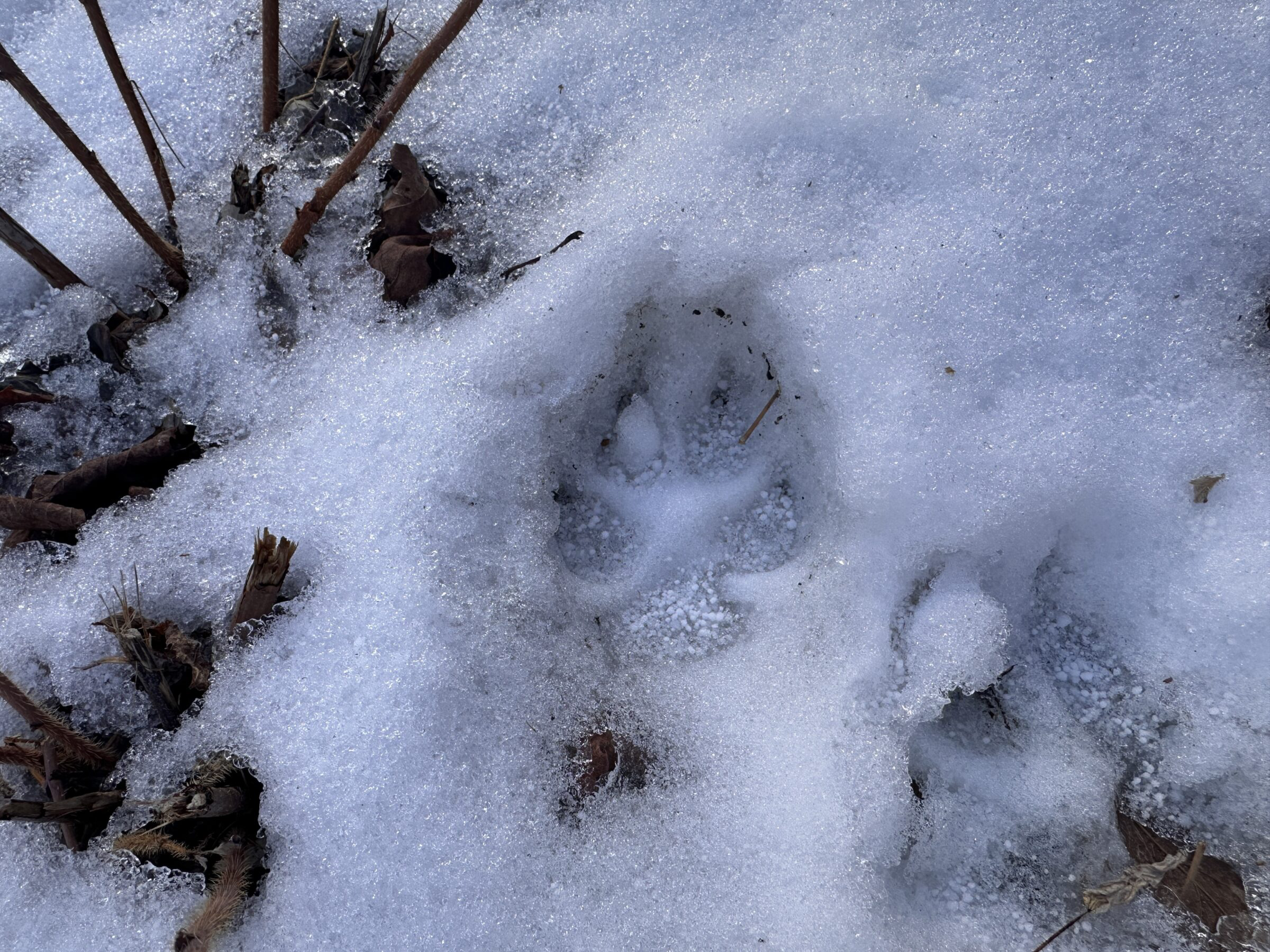
So, when the three of us were jarred awake, we all sat bolt upright and listened as the pack approached ever closer. Last week, a couple hours before dawn, our slumber was interrupted by a solitary coyote, scratching at the door, making cries that impersonated, believably, a cat in distress. I shudder to think of how that hunter had come by the expertise. In the morning, the looping path of paw prints in the snow confirmed just how determined the animal was to test the limits of my defenses.
Now, the yipping and screeching was twenty feet from my door. I imagined the horror of listening to the scratching and pawing of ten or more wild dogs attempting to work the door open in the middle of the night. I have a hatchet and a hunting knife as protection. Not particularly adequate against a platoon of hungry jaws. I consider traveling up to a fireworks shop up in New Hampshire and picking up a pack of M-80s. While not exactly a defensive weapon, tossed into a churning mass of bloodlust, the explosive would undoubtedly deafen the pack for a couple days and make them less certain of the wisdom of seeking prey at this particular address for a while.
I waited.
For long minutes, the incessant yelping continued just under my window. Just when I made up my mind to turn on lights and shout back at them out the door, they apparently gave up on their quarry of kittens and made their way westward up my driveway. Still screaming and laughing, the coyotes traveled off in search of other victims somewhere in the fields or ridge on the other side of the hollow. Three to five minutes later, they were gone.
And then the wolves arrived.
They didn’t announce their approach long in advance the way the coyotes do. They occupied the spot a couple dozen feet from my dwelling silently, and then, one of them let out a deep, throaty, sustained howl that wouldn’t be out of place in any backwoods horror movie. Two others joined in, and the song turned my innards to ice as I realized just how isolated a man can be only half an hour away from the nearest city.
Now, a little biology is called for. I have seen, in just the last two months, single wolves on Florida mountain and in East Hawley. I am told that these are coy-wolves. Science used to think that coyotes made their way from the western states over the Rockies and into New England sometime in the 1960’s or –70’s. More recent research, using DNA analysis, uncovered the truth. Coyotes migrated up into Canada and interbred with grey wolf populations and then dropped down into the U.S., with New York and Vermont being likely points of entry.
This new evidence explains quite a lot. When I lived in California and banged around the great Southwest, I encountered those local coyotes with regularity. They were small, scrawny, scrappy dogs who tended to be solitary in their doings and, while cunning, tended to be reclusive, mostly avoiding human contact.
Our coyotes are generally 30% – 50% larger than their Western cousins and engage in a much stronger, more consistent pack behavior when their environment favors it. And because interbreeding doesn’t occur on any predictable schedule or along predictable lineages, some of these coyotes are going to be smaller than others, resembling their recent ancestors, while others will be huge beasts, with the thick coats, markings, and bushy tails you’d expect to see in any full-blooded wolf.
And then, of course, there is the possibility that the Canadian wolves themselves are slowly following the migration patterns of their half-breed kin.
I’m sure you’ve heard it said that human contact with wild animals is on the rise. The explanation is almost always that people are encroaching into their habitats. This reasoning only tells half the story. Two and three hundred years ago, a town like Hawley was covered in pasture and grain fields. The forests had been cleared, first for shipbuilding lumber for the King, and afterward for livestock and crops. The evidence is plainly visible in the thousands of miles of stone walls deep in today’s woodlands.
Farms would reserve woodlots for firewood and lumber, which provided home for a small number of critters.
The apex predators, wolves and mountain lions (who have also begun to make a resurgence, no matter what the Department of Conservation says) were exterminated or pushed out, leaving foxes and bobcats as the dominant hunters of the era.
Today, Hawley (one of the largest towns in Massachusetts that no one has ever heard of) is comprised of about 60% forest that has been conserved, either by the Commonwealth or through the efforts of non-profit organizations, such as the Trustees of Reservation. A good number of privately owned acres are also returning to forest either through tax incentivized conservation programs or through the failure of small local agriculture operations to attract new generations of famers.
So, in a sense, the habitat into which humans are encroaching is that of the species that inhabited the region four centuries ago. Our well-intentioned, and valuable, efforts to preserve forestland are creating plenty of reclaimed space for large animals, moose and bear included. And while a sickening amount of farmland is being chewed up and converted into McMansion hellscapes, the nearby young forests have become the incubators for wildlife that understandably recognizes them as pretty sweet digs.
Including the the three coy-wolves (or wolves — if a coyote has 80% wolf DNA, it’s a fucking wolf, alright?) throwing their heads back and howling at the Christmas crescent moon outside my window.
Listening to the blood-curdling wail of the trio, I feel the exact same terror homesteaders must have felt when they arrived in the Hilltowns centuries ago to build a new life on stolen land and heard the call of hunger with desperate purpose. I am reminded starkly of how feeble my human body is compared to the raw power and instinct of animals that can survive and thrive out here in the wilds in sub-zero temperatures. And I am not comforted by the knowledge that wolves almost never attack humans. A woman was attacked by a coyote in Richmond just two weeks ago.
The kittens and I are transfixed by the carol of the howls. As chilled as I am by the tones welling up from deep in the chests of these antagonists, I can’t help but think of questions. Why is this second pack separate from the first? Wolves will eat coyotes as happily as they’ll breed with them — are the coyotes the intended prey? Are they just tracking the first pack to seize on whatever game the coyotes manage to flush out?
Also, on Hallowe’en night, I managed to record the howling of a lone wolf a few hundred yards away below the sugar shack. And then I heard it again last month — have her two companions been in the neighborhood the whole time, or has the brutal cold of the past month driven members of her tribe southward in search of more temperate climes? And lastly, are they here to stay?
I’ve been planning on raising livestock, maybe sheep, maybe cows, probably pigs. I’m certainly going to order some day-old chicks this Spring. How do I keep them safe when I’m surrounded by natural born killers? Donkeys are fantastic livestock guardians. So are several breeds of dogs, like the Hovawart or the Great Pyrenees. But then I have to come up with the money to feed and care for animals who will eat astounding amounts of dog food or grain and hay.
The scale of my farming would have to increase to justify the costs of protecting what I raise.
My Christmas wolves don’t hang around as long as the coyotes. After three or four minutes, the howling stops as suddenly as it began. They don’t depart with the noisy encore that the coyotes provided. They just…disappear.
The night passed anxiously, with the kittens waking me up with nervous mewls every half hour. I depart after breakfast to spend the holiday with family, telling Charlotte and Oberon, as I do every time I get in the car and leave them on their own, “Be careful, you two. Don’t go too far! Be stick-around kitties. And use your eyes, ears, and noses — the wolves are near.”
Please support my work with a small (or large) monthly donation through any of these gateways:
- Patreon: https://www.patreon.com/greylockglass
- Directly through our site: https://www.greylockglass.com/membership-account/membership/
- Steady: https://steady.page/en/greylockglass/about
…or by making a one-time contribution to my GoFundMe:
https://www.gofundme.com/f/indie-news-workingclass-voice-we-need-you
Stay safe.
— mongrel