







Residents invoke warnings of authoritarianism as council debates accepting $14,231 for a police evidence room — and refusing the federal conditions attached.
NORTH ADAMS, Mass. — Sarah Farnsworth came to the City Council with a librarian’s perspective on a police construction grant.
“You’ve probably heard that 1984 was not meant to be an instruction manual,” she said.
Rereading Ray Bradbury’s “Fahrenheit 451” during Banned Books Week (October 4 – 10), Farnsworth said, she had encountered passages she once understood as warnings about a future the country could still avoid.
“I reread it yesterday, and a disturbing amount of those things have come to pass,” she said.
Her concern was an agreement before the council to accept $14,231 in federal funding for improvements to the North Adams Police Department’s evidence room. The grant carried immigration-related conditions that residents warned could compromise local independence, expose the city to litigation, and undermine trust between immigrant communities and police.
“As a nation, we are consistently dismissing the alarms that have been given to us decades, three quarters of a century ago,” Farnsworth said.
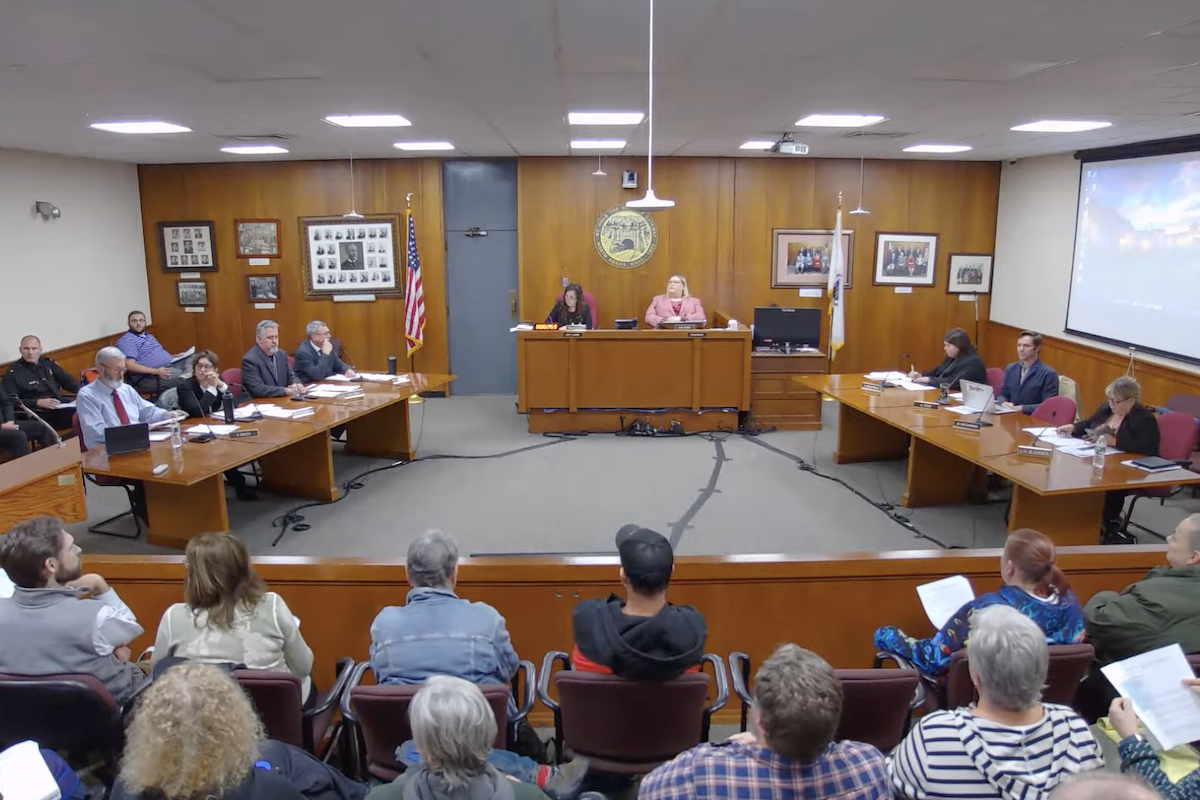
After extensive public testimony and more than an hour of council deliberation Oct. 13, councilors postponed action on the Edward Byrne Memorial Justice Assistance Grant until Oct. 27. They sought further information from the Massachusetts attorney general’s office, including whether the state would defend North Adams if accepting the grant led to a legal fight.
The debate concerned competing understandings of what resistance to federal pressure should look like: refusing money offered with objectionable conditions, or accepting taxpayer-funded assistance and challenging those conditions if Washington tried to enforce them.
For several residents, the consequences of choosing incorrectly would fall most heavily on people least able to participate in that debate.
“If someone has to pay for this mistake, it is not going to be anyone here in this room,” Farnsworth said. “It is going to be the people for whom it is too dangerous for them to come speak up.”
“North Adams is an immigrant city”
Richard Dassatti, of North Adams, opened public testimony against the grant by invoking the city’s immigrant history and the obligations that history carries.
“I believe that we should not cooperate with ICE in any way,” Dassatti said. “ICE has shown itself to be an organization which violates the rights of vulnerable members of our community and nation. I believe we must stand with our immigrant community against an organization which violates the civil and international human rights of our neighbors and friends.”
For Dassatti, that obligation was embedded in the city’s identity.
“North Adams is an immigrant city. We consider ourselves the Steeple City,” he said. “Those steeples were built by and for … our immigrant ancestors.”
Dassatti invoked the biblical command to welcome the stranger, quoting Leviticus: “You shall treat the alien who resides with you no differently than the natives born among you.”
He also recited Emma Lazarus’ “The New Colossus,” including its appeal to welcome “your tired, your poor, your huddled masses yearning to breathe free.”
“Our Statue of Liberty still stands in our harbor in New York City,” he said.
Turning to the Universal Declaration of Human Rights, Dassatti cited protections against arbitrary arrest, detention, and exile, along with the right to seek asylum from persecution. His opposition placed the grant decision within a larger question: whether the city would honor those protections and its own immigrant heritage.
“This is how fascism takes hold”
Peter May, of North Adams, rejected the idea that describing the grant in terms of authoritarianism was an exaggeration.
“It is not hyperbole to say that we are deep into a fascist takeover of our democracy,” he told councilors.
May characterized the immigration conditions as coercion: Accept Washington’s terms or lose the money.
“This is extortion, plain and simple,” he said.
“This is how fascism takes hold in seemingly small and progressive steps using violence, fear, intimidation, corruption, extortion and more, forcing obedience and compliance.”
He urged the city to raise the money locally instead.
“It is inconceivable that we will further compromise ours for a $14,231 bribe,” May said of American democracy. “We are better than that.”
Farnsworth likewise questioned whether constitutional protections and assurances about limited enforcement offered sufficient protection against an administration residents did not trust.
Her objection was not to the evidence room or to local police. She expressed respect for the department and its stated desire to avoid involvement in federal immigration enforcement beyond its legal obligations.
“I fear that this agreement could put them in the bind of having to choose between their morals and the law,” she said.
“I just don’t think this is a mistake we can afford to make.”
The questions behind the opposition
Other speakers pressed for specific answers about the agreement’s reach.
Shailja Patel, a poet and playwright from Williamstown, asked what the city solicitor believed the phrase “program or activity” covered, what information police could be required to provide to federal immigration authorities, and whether the conditions created tension with Massachusetts protections.
Patel also asked whether alternative funding existed and whether the solicitor’s written analysis would be available to residents.
“We the people deserve full, transparent and accountable answers to these questions before the Council can ethically and legitimately vote on this agenda item,” Patel said.
Fernando Leon emphasized that supporting secure evidence storage did not require supporting this particular funding agreement.
“I don’t think anyone here is disputing the value of improving the police department evidence room,” he said. “Secure evidence storage is a reasonable public safety goal.”
But Leon described receiving about a dozen calls each week from people asking whether Immigration and Customs Enforcement agents were in town.
People need to feel safe reporting crimes, cooperating with investigations, seeking services, and calling for help, he said. Accepting federal conditions could cause them to question whether contact with local police might expose them or their families to immigration enforcement and separation.
“Please separate the project from the federal conditions,” Leon said. “Fund the evidence room, but do not compromise the community trust in doing so.”
How far would the conditions reach?
City Solicitor Joel Bard offered a narrower interpretation of the agreement than the one residents feared.
Reading his legal opinion into the record, Bard emphasized language tying the disputed restrictions to the funded program or activity — in this case, improvements to the evidence room.
“The evidence room serves the purpose of storing evidence,” he said. “Not people, not personnel.”
Bard described provisions concerning disclosure of federal law enforcement information, communication of immigration-status information, access to correctional facilities for interrogation, and notification of scheduled releases.
He said immigration-related grant conditions had been subject to extensive litigation and concluded that, given ongoing challenges, “it is unlikely that these conditions could be enforced against the city.”
That qualification became a central point of discussion.
Councilor Lillian Zavatsky challenged the assumption that an evidence room would necessarily fall outside the interests of immigration authorities. She described a hypothetical request asking whether the department held evidence associated with a particular person.
Bard acknowledged that such a situation could invoke the provisions, while emphasizing the uncertainties involved.
His assessment offered reassurance about the likelihood of enforcement, but no guarantee that accepting the grant would be without consequences.
Resident Hari Kumar questioned whether earlier legal victories against federal coercion could safely predict the outcome of challenges to newly imposed conditions.
“We have no guarantee that this current Supreme Court will protect our 10th Amendment rights against coercive control by the federal government,” he said.
Kumar asked whether councilors had received advice from the Massachusetts attorney general and challenged them to consider the stakes beyond a single construction project.
“Is it really worth gambling our civil rights for $14,000?” he asked.
“And it’s not just the civil rights of immigrants, it’s the civil rights of all of us who live here in North Adams.”
“You’re actually signing all of us up”
Michael Hitchcock argued that a decision by North Adams could affect people throughout Berkshire County.
Residents cross municipal boundaries for work and services, he said. A police department’s information practices therefore have consequences beyond the people who live within its jurisdiction.
“When one police department signs an agreement to share unlimited and unknown information with Department of Justice, you’re actually signing all of us up for that,” Hitchcock said.
That was his characterization of the agreement’s potential reach; Bard’s interpretation was substantially narrower.
Hitchcock described immigrants as “our friends, neighbors, and coworkers” and warned that federal scrutiny could extend to political activity as well.
“What you’re doing is thinking about receiving $14,000 in exchange for being on a list where DOJ can do occasional fishing expeditions,” he said.
Kate Abbott, of Williamstown, focused on the conditions themselves, citing provisions involving information restrictions, notification of release, and interrogation.
She asked councilors to consider both what an immigration official could require and what one could prevent.
“What I hear in those four very broadly stated conditions,” Abbott said, “are that my loved ones and friends and neighbors can disappear.”
Signing an agreement while promising defiance
A speaker identifying herself as [Virginia — confirm full name, 00:43:18] questioned the wisdom of entering an agreement with a federal government she described as repeatedly breaking commitments and disregarding legal constraints.
“You would not have a roofer who had that record,” she said. “You would not hire them, I would hope.”
She also raised a question that would become particularly relevant as officials discussed accepting the grant while refusing its disputed conditions: What legal exposure might follow from signing an agreement with an announced intention not to comply?
The speaker raised potential liability under the False Claims Act. The meeting did not resolve that question.
She also warned that defending the city could consume more than the grant provided.
“I guarantee you, you cannot go to court for less than $14,000,” she said.
The possibility of litigation became central to the council’s eventual decision to seek state assistance before acting.
Money without those conditions?
Councilor Peter Breen identified a possible alternative: $15,624.61 that McCann Technical School was returning to North Adams.
He said the money was going into the general fund without an existing allocation and suggested using it for the evidence room.
“No strings attached,” he said.
Breen supported the improvements, describing his own experience with police recovering and safeguarding property stolen from his home. But he questioned accepting uncertainty about federal obligations when another source might cover the project.
He also highlighted condition 26, which he read as requiring compliance with additional requirements imposed by the DOJ awarding agency.
“How do you know that something’s not going to happen?” he asked. “It’s not even written.”
The council did not approve an alternative appropriation that evening.
“I would rather fight”
Police Chief Bailey said the grant would not change the department’s existing practices.
He said North Adams police do not hold people beyond their release on criminal matters to accommodate civil immigration detainers, and do not accompany ICE to search for people on that basis.
But Bailey argued that declining grants would leave objectionable federal conditions unchallenged. Other funding opportunities were at stake, he said, including a prospective $250,000 records management grant.
“The only way we’re going to get those provisions removed is if we fight back and have them removed,” he said.
Councilor Lisa Blackmer likewise warned that the financial consequences could accumulate if the city repeatedly rejected federal assistance. She said constituents had contacted her to question why the city would turn the money down.
“I don’t think voting against this grant as a way to flip off ICE and the administration … is necessarily the way to go,” she said.
Councilor Andrew Fitch described struggling to balance the funding opportunity against residents’ concerns.
“There’s a real value associated with making our public feel heard and feel valued and feel respected and feel protected,” he said. “And that’s worth way more than $14,000.”
He said he could not support accepting the grant as matters stood.
Council President Ashley Shade argued that the money belonged to taxpayers and that fear of federal retaliation should not dictate the city’s decisions.
“Whether we sign that contract or not, we are not going to comply with those provisions,” she said. “Zero compliance.”
“I would rather fight,” Shade said. “I’d rather let them come at us and take it to court and show them that we’re not afraid.”
But the city also had a responsibility to protect its budget, she said. She wanted to know whether Massachusetts would provide a legal defense.
Zavatsky challenged the framing of opposition as fear.
“I don’t think it is coming from a place of fear to vote against this,” she said.
She also questioned signing an agreement after publicly declaring an intention not to comply and urged North Adams to adopt a local immigrant protection ordinance establishing clear municipal commitments.
Who would defend North Adams?
The council ultimately postponed the decision until Oct. 27 and sought an update from the attorney general’s office on the litigation and the prospect of a state-funded defense.
Councilor Alexa MacDonald requested a written response that could be included in council packets and made available to residents.
Blackmer emphasized the distinction between an expression of support and a commitment to represent the city.
“Backing is a letter of support,” she said. “Defending means it’s on the state’s dime.”
The postponement left the grant unaccepted and the central disagreement unresolved.
Some officials saw accepting the money as an opportunity to challenge federal pressure. Residents questioned whether entering the agreement would expose the city — and people who might never enter the council chamber — to consequences that assurances about unlikely enforcement could not eliminate.
For Farnsworth, the warnings in Orwell and Bradbury were inseparable from that immediate decision.
“I think we can really find another way to fund this,” she said.